Why a Number Needs Its Denominator
Why a number needs its denominator: learn to identify the group behind a proportion, compare claims fairly and judge what a reported share can mean.
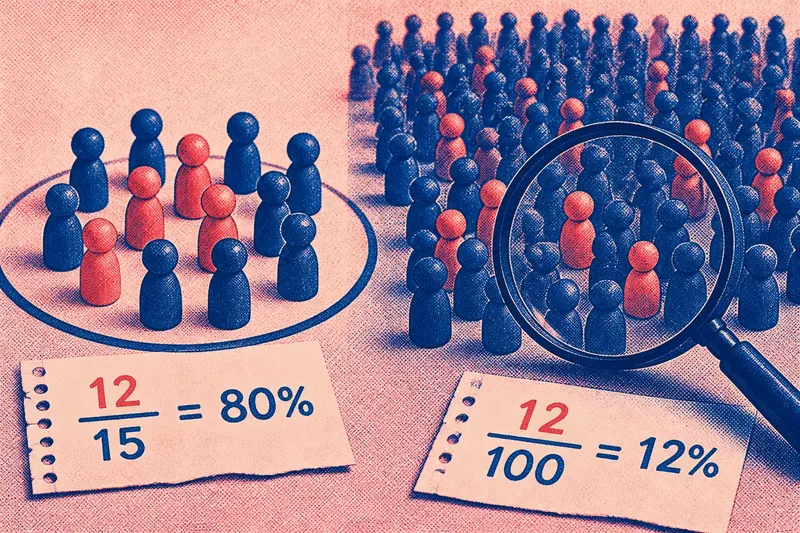
A report says that twelve people supported a proposal, but the number means little until you know how many people were asked. Why a number needs its denominator is a question about the whole group behind a proportion: twelve of fifteen is a different claim from twelve of a hundred. The numerator tells you how many cases meet a condition; the denominator tells you how many cases the proportion is drawn from.
That distinction matters in news, public notices and everyday conversation because a count can sound complete while quietly leaving its reference group unstated. To read the claim well, first identify what is being counted, then find the whole group that gives the count its meaning. There are several useful ways to do that, depending on whether the denominator is stated, implied or missing.
Counts and proportions
A count is a raw number: twelve supporters, six complaints or three applications. A proportion compares that count with a defined whole. If twelve of fifteen respondents support a proposal, the proportion is twelve divided by fifteen; if twelve of a hundred do, the count is unchanged but the share is much smaller.
The denominator is the number below the line in a fraction. In ordinary reporting, it may be expressed as “of those surveyed”, “among registered users” or “out of all applications received”. These phrases name the relevant whole, though they do not by themselves tell you whether that whole is the right one for the claim being made.
Consider an invented example. A fictional library asks visitors at one branch whether they would use a proposed evening reading group. Twelve say yes. If fifteen visitors answered, the result describes a strong preference among those respondents; if a hundred answered, it describes a much smaller share. In either case, it says nothing directly about people who did not visit that branch or did not answer.
The denominator is therefore more than arithmetic. It sets the boundary of the statement. “Twelve people said yes” describes a count; “most respondents said yes” makes a proportional claim; “most residents want the group” reaches beyond the respondents and needs a basis for doing so.
Three ways to read a share
When a claim gives a number, you can approach it in three ways. None replaces the others: each answers a different question about what the number can support.
- Use the stated denominator. If the report says “twelve of fifteen respondents”, read the result as a description of those fifteen. This suits a reader who wants to understand the claim exactly as reported, without enlarging its scope.
- Ask for the missing denominator. If you see “twelve people agreed” or “a quarter of users complained”, ask how many people or users were included. This suits a headline, chart or public message that offers a count or share without naming its base.
- Compare like with like. When two groups or periods are being compared, check that each share uses a clearly comparable whole. This suits claims about changes or differences, where the comparison can mislead if one denominator covers a different kind of group.
Say a fictional community centre receives twelve requests for an evening class in one month and twelve in another. In the first month, thirty people submitted class preferences; in the second, sixty did. The equal counts do not mean equal levels of interest: the first count is a larger share of its respondents. The careful description keeps both the count and the denominator visible, rather than treating the raw totals as a trend.
Comparison also depends on what was counted. “People contacted” may not mean “people who replied”, and “applications received” may not mean “eligible applications”. A change in the denominator can reflect a change in recruitment, eligibility or response, rather than a change in underlying opinion or behaviour.
Choose the right whole
Finding a denominator is not simply a matter of locating any nearby total. The right whole is the group that the statement is actually about. For a claim about survey respondents, the denominator is usually the number who answered that question, not everyone invited. For a claim about all members, a respondent-only denominator may not justify the wider wording.
Look for the boundary in the wording. Ask who could be included, who was actually included and which cases were excluded. If the claim concerns “customers”, does that mean everyone who bought something, people who opened a feedback form, or only those who submitted a response? Each group can produce a different proportion.
It is also useful to distinguish a group’s size from its representativeness. A stated denominator tells you how many cases form the base, but not whether those cases resemble the broader population. A large group can still exclude relevant voices; a smaller group can be useful for describing itself while remaining too narrow for a general claim.
That is why careful wording often names both the group and the scope: “Among the people who completed the form, twelve supported the proposal.” This is less sweeping than “the community supports the proposal”, but it tells readers what the count can actually show. If someone wants to make a broader claim, they need to explain how the respondents relate to the wider group.
When is the denominator clear?
What if a report gives only a count?
Treat the number as a count, not as evidence that the outcome is common or rare. Look nearby for the total invited, eligible, contacted or responding, and ask which of those totals matches the claim.
Does a larger group settle the question?
No. A larger denominator can make a proportion more informative about the group counted, but it does not repair a group that was selected in a way that excludes important people. Read the method and scope as well as the total.
Can two proportions be compared directly?
Only if the groups and counting rules are sufficiently alike for the comparison being made. Check that both figures refer to comparable periods, eligibility rules and response stages; otherwise, the apparent difference may partly reflect different denominators.
What if the denominator is not published?
Keep the claim provisional and avoid turning it into a broader statement than its wording supports. A reader can ask the publisher for the base and the group definition; if neither is available, the proportion cannot be properly interpreted.
Match method to claim
Choose among the three approaches by starting with the claim’s purpose. If it simply describes a defined set of respondents, use the stated denominator and preserve that narrow scope. If a number is presented without its base, seek the missing total before judging its weight. If the point is a comparison, check the two bases side by side before deciding what changed.
For a quick reading, mark the number and its group in the same sentence: “twelve of fifteen visitors”, not merely “twelve visitors”. Then ask whether the claim stays within that group. This small habit separates a count from a share and a share from a claim about people who were never counted.
It is not worth calculating a decimal share just to make a vague claim look precise. If the group is unclear, arithmetic cannot supply the missing boundary; plain wording that names what is known is more useful.
Why a number needs its denominator comes down to a modest but important discipline: keep the whole group attached to the part being reported. Once you know who is in that whole, you can judge whether a count describes a set of cases, whether a proportion supports a comparison, and where the evidence stops.