A Three-Pass Reading of a Developing Story
A three-pass reading of a developing story helps you track what has changed, separate settled details from open questions and avoid mistaking updates for a full record.
A three-pass reading of a developing story turns a stream of updates into a clear record of what has changed and what remains unresolved. Instead of rereading every alert as though it were a complete account, note the story’s timeline, compare its versions and track how its public framing shifts.
This approach is useful when a council, transport operator or emergency service is issuing notices about an unfolding event. Focus on the information’s movement: which details appear, disappear or become more specific, and how those changes affect the account readers encounter.
Build a timeline
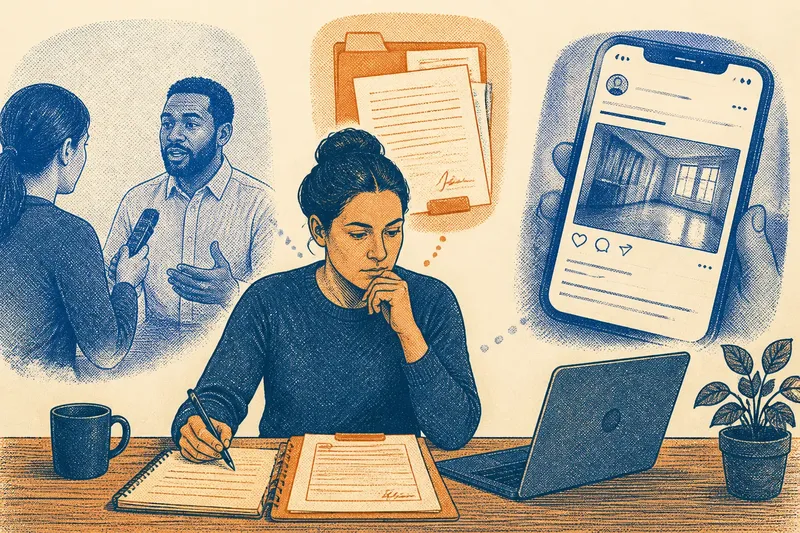
Keep each relevant version in one notes app, document or sheet of paper. Record its displayed time, publisher and link, then give it a short label such as “initial notice” or “afternoon update”. These details help distinguish a new statement from a page that has been refreshed without a clear change log.
For each version, note three things: its main point, the new information it contains and any question it leaves open. Avoid copying full articles. A short description such as “road closure now includes the eastern entrance” is easier to compare than a long extract.
Keep only updates that add a detail, change a public instruction or alter the account’s scope. Collecting every repost or repeated alert is not worth the effort: it creates a larger archive without making the sequence easier to understand.
First pass: map the account
Read the latest version for its structure and intended takeaway. Notice what appears in the headline, opening paragraph, update note and any practical instructions. Then write a neutral description of the event without adding a cause, motive or consequence that the account does not establish.
Separate the event from the way it is being presented. A transport notice might say that a station entrance is closed and direct passengers to another entrance. The first detail describes a change in access; the second tells readers what action the publisher wants them to take.
Also note what the account leaves out. If a notice says a building is closed but gives no reason or reopening time, record those as unanswered questions. Missing context can shape readers’ expectations even when no false statement appears.
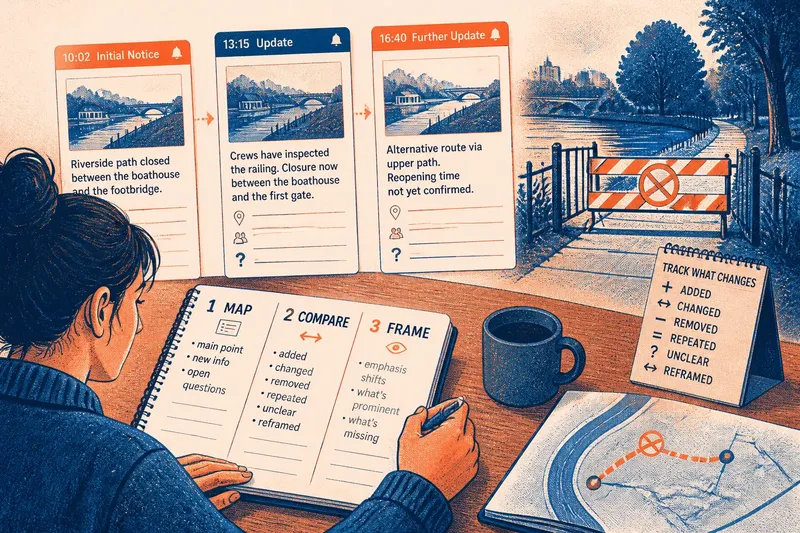
Imagine a local authority posts that a riverside path is closed while crews inspect a damaged railing. Your first note could read: “Path closed; inspection under way; repair status and reopening time not stated.” This records the event, the stated action and the practical uncertainty without turning an inspection into a claim that the path is unsafe everywhere.
Second pass: compare versions
Place the latest version beside the previous one and compare their content, not just their headlines. Look for changes in the stated location, affected group, requested action, explanation or timetable. A headline may become shorter while the body carries the meaningful revision.
Use a small set of labels to describe what happened to each detail:
- Added: A new location appears; if it changes who is affected, update the scope of your note, otherwise keep it as background.
- Changed: The stated status or instruction differs; if the new wording clearly replaces the old one, mark the earlier version as superseded, otherwise retain both and note the unresolved difference.
- Removed: A detail no longer appears; if the new version explains its removal, record that explanation, otherwise leave the reason open.
- Repeated: The same information returns without a substantive change; if it adds no context or instruction, do not count it as a new development.
- Unclear: The versions cannot be matched confidently; if the page gives no explanation, preserve both descriptions rather than inventing a timeline.
- Reframed: The headline or opening shifts emphasis; if the body supports the new emphasis, note the change in presentation, otherwise describe the difference without treating it as a new fact.
For a worked invented situation, imagine the first notice says the riverside path is closed between the boathouse and the footbridge. A later notice says crews have inspected the railing and the closure now applies only between the boathouse and the first gate. Compare the boundaries, record that the closed section has narrowed, and keep the reopening time marked as unstated; the result is a clearer access picture, not proof that all repairs are complete.
Third pass: trace the framing
Return to the earlier versions and ask how the latest wording changes the story’s emphasis. A notice that first foregrounded disruption may later foreground a workaround. That shift can be useful to readers, but it does not erase the earlier disruption or establish that everyone can use the alternative.
Track which details are made prominent and which recede. A revised headline, a new map or a changed ordering of instructions may affect what readers notice first. Record the change in presentation separately from any change in the underlying event.
If two versions appear to conflict, check whether they describe the same place, time and group. “The whole park is closed” and “the riverside route remains closed” could refer to different boundaries. If the account does not clarify the relationship, keep the descriptions separate and note what remains uncertain.
Silence in a newer version does not resolve an earlier point. If the first notice gave a reason for a closure and the next one omits it, record the omission; do not assume the reason has been withdrawn or confirmed.
How should you track updates?
Which version belongs in the record?
Keep the earliest notice and each later version that changes a fact, instruction, scope or emphasis. If a page repeats the same text with a new timestamp, note that it was refreshed but do not treat the timestamp alone as a substantive update.
What should you do with a correction?
Record the corrected wording and, if visible, the earlier wording it replaces. If the correction does not explain why the text changed, note that the reason is unstated rather than supplying one.
How can you tell whether the public instruction changed?
Compare the requested action and the group it applies to, such as which entrance to use or which route to avoid. If the instruction is unchanged, keep it as continuing guidance; if it differs, identify the newer instruction and preserve the old version in the timeline.
When is another check useful?
Return when the publisher announces a meaningful change, such as a revised boundary or a new practical instruction. If several alerts repeat the same message, set the story aside until there is a substantive update.
Share the sequence clearly
When passing on an update, state what changed and what did not. For instance: “The notice now limits the riverside closure to the section by the boathouse; it still gives no reopening time.” This tells readers how the account developed without presenting an unfinished process as a final outcome.
For a three-pass reading of a developing story, keep separate notes for the event, the public instructions and the changing presentation. That separation is especially useful when a new headline attracts attention but the practical details remain the same—or when a small change in scope alters what readers should do.