Interview, Document or Post: What Each Source Can Show
Compare interviews, documents and online posts to see what each source can establish, what it leaves out and which follow-up question to ask.
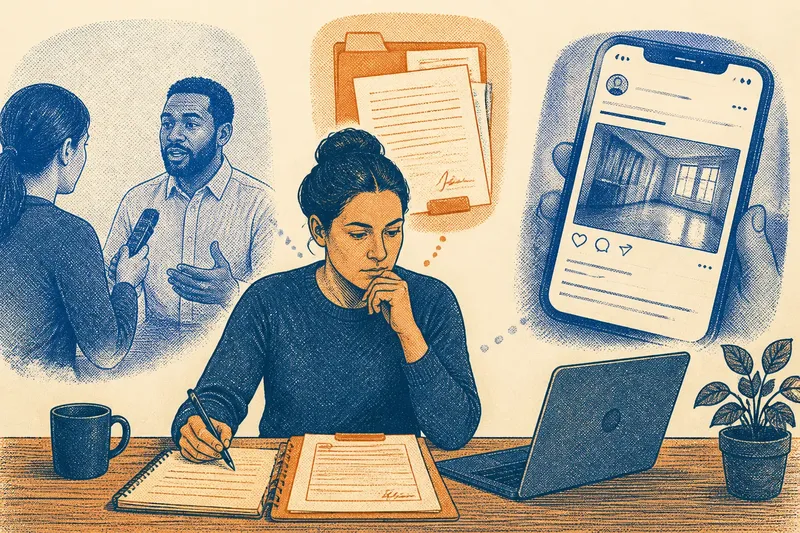
An interview, a form and a social media post answer different questions about the same event. To assess an interview, document or post, start by asking what kind of trace it contains: a person’s account, a recorded entry or content displayed online.
Source types
An interview gives testimony: what a person says they experienced, noticed or heard. It can offer detail about perception or informal practice, but memory and access shape what the person can describe.
A document preserves recorded material, such as a signed form, meeting minutes, a letter or a policy. It shows what was written or formally entered, but its purpose and omissions matter. Minutes, for instance, may select parts of a meeting rather than reproduce every exchange.
An online post leaves a public trace of words, images or video shared through a platform. An original post may retain its caption and visible replies; a screenshot captures only the portion its maker chose to include.
Interview boundaries
When someone describes an event, separate what they directly perceived from what they inferred or learnt from another person. “I was in the room” describes access; “I knew they had agreed” may be an interpretation.
Ask about timing, location and uncertainty. A witness may describe what was visible from one position without knowing what happened elsewhere. Hesitation alone does not show that an account is wrong.
Testimony may explain how a form was completed or why a meeting ended early. Keep that explanation distinct from the document: the interview adds context but does not change what the record says.
Document boundaries
A record can preserve wording, signatures, dates written on a form or the sequence of entries in a log. A blank field shows that no information appears in that space; it does not, by itself, explain why.
Check who made the document, for whom and through what process. A draft may have changed, a copy may lack attachments, and a cropped page may hide a heading that defines the section. If exact wording matters, locate the complete version and check whether it is final.
Also consider what the record was designed to do. A policy states an intended rule, while a completed checklist records a particular inspection. Neither alone tells you how consistently the rule was followed.
Post boundaries
Distinguish the post from the claim made about it. If sufficiently complete and authentic, a post can show that certain words or an image appeared on an account. It does not, by itself, establish that the words are true or that the image depicts the accompanying claim.
Check the account, date and surrounding material. A profile name alone does not establish who controlled the account; a timestamp may depend on platform settings; a short video may begin after the action that explains it. Treat these as questions to investigate, not automatic reasons to dismiss the post.
A repost can detach an image from its original caption, while a screenshot may omit replies or other page details. When timing or authorship matters, compare the capture with the original page or another independent record.
Questions about sources?
Can an interview establish an event?
An interview records a person’s account of what they experienced or heard. Its value for a disputed event depends on their access, the detail they can provide and whether other material supports or complicates the account.
Is a document more reliable than a person?
Not by default: a document may be incomplete or serve a narrow purpose, while a person may have direct knowledge that was never recorded. Judge each against the question and how the source was produced.
Does a screenshot show the original post?
A screenshot shows captured content, not necessarily the live post, its full context or its history. The original page or another independent record may clarify who published it, when it appeared and what the capture leaves out.
How should conflicting accounts be handled?
Separate what each source directly records from the interpretation built on it. Then check for a specific reason for the difference, such as a limited viewpoint, a missing page or a clipped post, rather than blending the accounts into one confident version.
Choose a source
Match the source to the question. For “What wording was entered on the form?”, inspect the form; for “What did the clerk say?”, an interview or recording is closer; for “What did the account publish?”, seek the original post rather than a paraphrase.
Say you are checking a notice shown in a screenshot. You find the complete post, whose caption names a different room from the one mentioned in an interview. The discrepancy tells you to ask whether the interviewee saw that particular notice; it does not settle which account is mistaken.
If the question matters, pair sources with different limits. Testimony may explain a record, while the record may anchor a recollection. Several copies of the same post add little if they all trace back to one original account.
Practical source checks
Use these checks to choose a proportionate next move. Each result points to an alternative action rather than a verdict about the source’s overall worth.
- Check whether an interviewee saw the event directly; if they did, use the account for their stated observations, but if they heard about it from someone else, seek that person or a contemporaneous record.
- Check whether a document is complete and final; if it is, use its wording for the recorded entry, but if pages or attachments are missing, locate the full version before interpreting omissions.
- Check what a form’s blank field means in its layout; if the instructions define it as optional, do not treat the blank as a failed entry, but if its meaning is unclear, consult the form’s guidance or creator.
- Check whether a post is still available at its original address; if it is, compare its caption and replies with the claim, but if only a screenshot remains, describe it as a capture and seek corroborating material.
- Check whether a video includes the moment relevant to the claim; if it does, assess that visible sequence, but if it begins later, seek a fuller recording or another account of what preceded it.
- Check whether two sources are independent; if they derive from separate observations, compare their points of agreement and difference, but if they repeat one source, treat them as one underlying account.
State the limit
Describe what the source itself records, rather than using it to settle a broader question. “The minutes record an objection” says what appears in the document; it does not claim that everyone opposed the plan. “The account posted a photograph” identifies a public trace without claiming the image proves the event occurred as described.
It is not worth tracking every possible version when the question does not depend on it. If exact wording is central, the complete original record matters; if it is not, broader context may be enough. For an interview, document or post, make clear which part supports your account and which part remains unresolved.