The Headline Verb That Changes the Claim
Headline verbs shape how readers interpret a story’s claim. Learn to spot who is speaking, what the verb implies and when a headline shifts the emphasis.
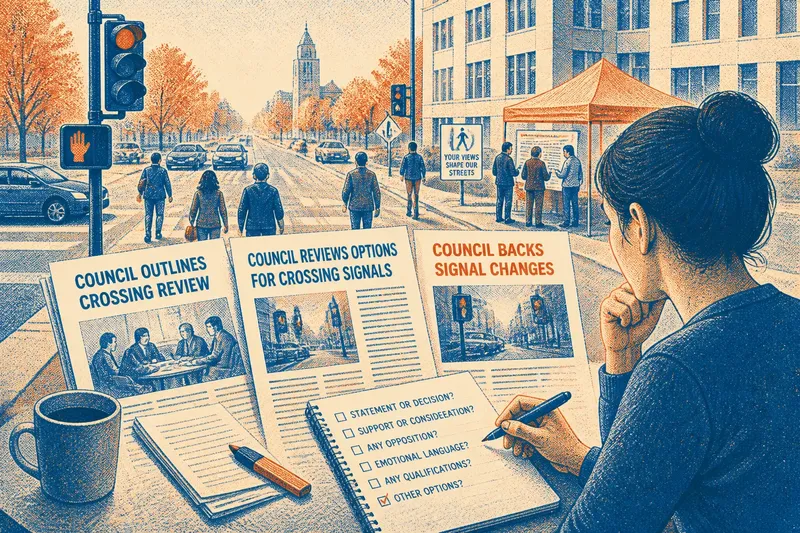
A headline can turn an ordinary announcement into a confrontation with one verb. “Council outlines a crossing review” directs attention to a process; “Council challenges crossing plan” suggests opposition, even if the story describes no such dispute. To read headline verbs carefully, notice not only how strongly they state a claim but also which part of the story they make prominent.
Verbs set the frame
Headline verbs select a relationship between people, events and ideas. “Announces” points to a public statement, “backs” suggests support, and “rejects” signals opposition. Each choice encourages readers to organise the story around a different action.
That framing can be accurate while still narrowing the reader’s view. A council may announce a review that includes several options; a headline led by “backs” may make one option seem like the whole story. The useful question is not only whether the verb is defensible, but what it makes easiest to notice.
Some verbs also carry emotional weight. “Admits” implies reluctant disclosure, “slams” presents forceful criticism, and “reveals” suggests that previously hidden information has come to light. These implications may fit the article, but they should not be treated as neutral descriptions.
Find the missing emphasis
Read the headline alongside the opening paragraphs and ask what action or viewpoint receives the most attention. Then look for other details that could change the shape of the story: a response, a condition, a disagreement, or a decision that has not yet been made.
Say a fictional council publishes a statement describing a review of crossing signals, an option to change their timing, and a request for residents’ views. A headline reads, “Council backs signal changes”. The statement supports that the council is considering a change, but the verb makes support sound settled. A reader checking the text would distinguish an option under review from an adopted decision.
In that invented situation, a headline such as “Council reviews options for crossing signals” would foreground the process instead. It would not capture every detail, but it would avoid making a proposal sound like a final choice. The difference is one of emphasis, not simply a choice between true and false.
Check the framing
Use these checks to identify what a headline’s verb adds and decide how to describe the story:
- Identify the action. If the article records a statement but the headline says “orders”, check whether anyone actually gave an instruction; if not, describe the statement rather than an order.
- Look for a decision. If the text presents an option for discussion but the headline says “backs”, check whether support was formally expressed; if not, say the option is under consideration.
- Check for opposition. If the verb is “rejects” or “slams”, find the passage showing a refusal or criticism; if the text only raises questions, describe the questions without implying a clash.
- Notice emotional force. If “admits” or “reveals” makes an ordinary disclosure sound reluctant or concealed, check what the article says about that context; if it offers no such detail, use a less loaded description.
- Find the qualification. If the headline sounds final but the article mentions a condition, proposal or unresolved point, retain that qualification when retelling the claim; if the article contains no qualification, do not add one.
- Compare the available actions. If the headline centres one proposal while the text describes several, check whether the others affect the story’s meaning; if they do, mention the broader choice rather than presenting one option as the whole decision.
For the fictional signal review, the starting information is a review, a possible timing change and a request for public views. Reading those details in order leads to a narrower account: the council is considering signal options, not announcing an adopted change. The trade-off is clear: the broader wording is less dramatic, but it preserves the decision’s status and leaves room for the other options.
Questions about framing?
Does a forceful verb make a headline false?
Not necessarily. A forceful verb may accurately describe a clear action, but it can also make a minor disagreement sound central or settled. Compare its implication with the article’s account before deciding how much weight to give it.
What is the difference between “backs” and “considers”?
“Backs” usually signals support, while “considers” describes an option still under discussion. If the article reports a review without a decision, “considers” better preserves that unresolved status.
Why do headlines use loaded verbs?
A short headline has limited room, and a vivid verb can quickly indicate conflict, support or change. That convenience does not tell you whether the emphasis is proportionate, so check what action the article actually describes.
How should I retell a loaded headline?
State the concrete action or position described in the article, then retain any condition that affects its meaning. If the headline implies a decision but the text describes a proposal, call it a proposal rather than repeating the stronger framing.
Choose the useful detail
Not every shift in emphasis deserves a lengthy investigation. It is not worth guessing at a publisher’s motive from a single word; the word alone cannot show whether the choice was deliberate, careless or simply compressed. Focus instead on the visible gap between the headline’s frame and the article’s account.
When you encounter headline verbs, ask what they make the reader expect: an announcement, a decision, a conflict or a discovery. Then check whether the article provides that action or merely discusses it. This habit helps you pass along the central event without inheriting an emphasis the text does not support.