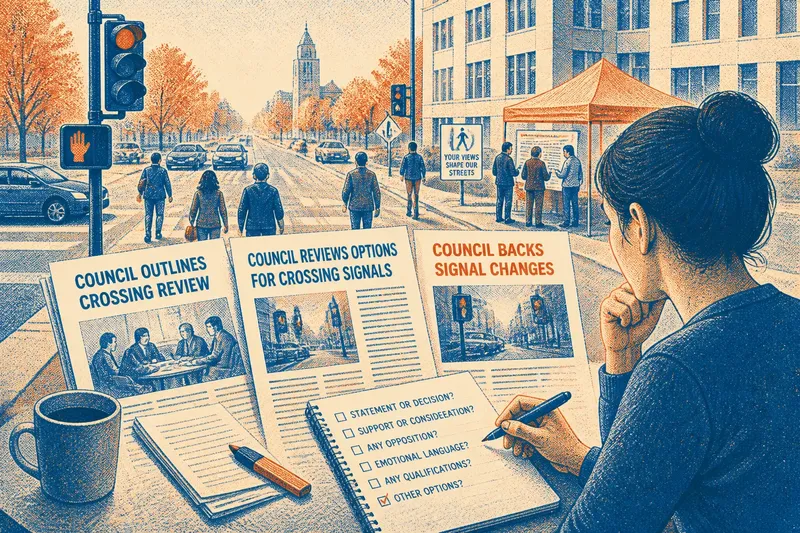
The Neutral Wording Myth: How Summaries Shape What Readers Notice
The neutral wording myth obscures how summaries select details. Learn to spot naming, order and omission without assuming a writer’s intent.
A summary can be accurate and still direct attention: the neutral wording myth overlooks how a writer chooses what to name, where to begin and what to leave out. Those choices do not automatically reveal bias or bad intent, but noticing them helps you understand what the wording makes easier to see.
What is the neutral wording myth?
The neutral wording myth is the assumption that a summary can report an event without making any choices about emphasis. Even a short, careful account has to select details from a larger set; there is no way to include everything at once.
That does not mean every summary is unfair or that all versions are equally useful. A summary may be accurate, clear and proportionate while still giving some details more prominence than others. Neutrality is better treated as a question about specific choices than as a label that settles the matter.
Does selection mean bias?
No. Selection is unavoidable; bias is a possible pattern or effect that needs evidence of its own. A writer may lead with a detail because it answers the reader’s immediate question, fits a word limit or is supported by the available information.
To assess a summary, separate what you can observe from what you are guessing. “The first sentence names the disruption but not who was affected” describes the wording. “The writer wanted to hide the impact” assigns a motive that the sentence alone cannot establish.
More than one summary can therefore be defensible. One may orient readers around a decision, another around its consequences. The useful question is not whether a summary is perfectly neutral, but whether its choices leave a misleading impression or conceal context readers need.
How does naming shape a summary?
Naming determines which people, groups, actions or institutions become visible. Compare “Officials changed the timetable” with “The timetable changed.” Both might describe the same event, but only the first identifies an actor. If responsibility matters, that difference is worth noticing.
Labels also carry associations. “Residents”, “commuters” and “customers” can refer to overlapping people while inviting different questions about their interests. A label is not automatically manipulative; check whether it is precise, supported and appropriate to the detail being summarised.
Pronouns and passive constructions can blur relationships too. In “A notice was issued after the meeting”, the sentence leaves the issuer unnamed. That may be reasonable if the issuer is unknown or irrelevant; if the account concerns who made a decision, the missing actor may matter.
Why does order matter?
Readers usually encounter a summary in sequence, so the opening detail helps set the frame for those that follow. Starting with a delay may make inconvenience the organising concern; starting with the decision that caused it may make responsibility more prominent.
Order is not proof of a hidden agenda. A writer may begin with the most recent development, the answer to a reader’s likely question or the detail that makes the rest intelligible. To judge the effect, ask what the first sentence leads you to expect and whether later details alter that expectation.
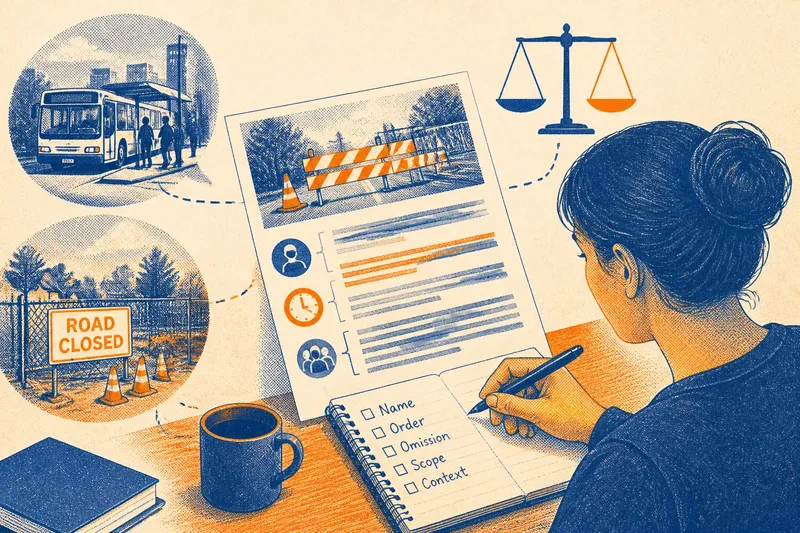
Imagine a town notice about a road closure and a temporary bus change. If it opens with the bus change, a reader may first think about journeys; if it opens with the closure, the cause comes into view sooner. Both openings could be accurate, but each gives the reader a different route into the same update.
What can omission tell you?
An omitted detail matters when its absence changes a reasonable reader’s understanding. A summary that mentions a new rule but not when it begins may leave readers unable to tell whether it affects them now. A missing qualification may make a limited claim sound universal.
Not every absent detail is a flaw. Summaries have limited space, and background that does not alter the main point can distract. Look for the relationship between what is included and what is missing: does the omitted information clarify scope, responsibility, timing or consequence?
When possible, compare the summary with the fuller statement or source it describes. Check whether the summary preserves qualifications and distinguishes what is known from what remains uncertain. If the source is unavailable, mark the gap as a question rather than filling it with an assumption.
How can you check wording without guessing intent?
Use a simple sequence: identify the choices you can point to, consider their effect, then check the context that could confirm or change your reading. This keeps attention on the text rather than turning a suspicion about motive into a conclusion.
- Name: Who or what is identified, and who is left unnamed?
- Order: Which detail appears first, and what expectation does it set?
- Omission: Is a qualification, timeframe or affected group needed to interpret the claim?
- Scope: Does the wording describe one case, a limited group or a general rule?
- Context: Can the original statement or another reliable account clarify the selection?
Say you read a notice stating, “The library will close early during the repairs.” You can observe that the sentence names the closure and its reason but does not give a date or say which branch is affected. Before calling it evasive, check the surrounding notice; it may supply those details, or the missing information may genuinely make the summary hard to use.
What is not worth the effort is treating every ordinary choice of word order as evidence of deception. A close reading is most useful when it identifies a concrete effect and leaves room for a plausible explanation.
Which questions help you judge a summary?
Can a summary be fair if it leaves details out?
Yes. Fairness depends partly on whether the selected details preserve the meaning and limits of the fuller account. Leaving out a background detail is different from dropping a qualification that changes what the claim means.
How do I tell framing from factual error?
A factual error conflicts with what the available evidence supports; framing concerns which supported details are emphasised or arranged. A summary can contain no obvious falsehood and still foreground one consequence while barely mentioning another.
Should I trust a summary that uses plain language?
Plain language can make an account easier to follow, but simplicity alone does not show whether the selection is complete or proportionate. Check the named actors, scope and omitted qualifications just as you would in denser wording.
What should I do when the original source is missing?
Distinguish the summary’s direct claims from details it does not establish, and avoid treating absence as proof of intent. You can seek another account or wait for fuller context if the missing point affects a decision.
What does neutral wording require?
Neutral wording is not a view from nowhere; it is a discipline of making choices responsibly. A clear summary uses specific labels, gives context in an order that readers can follow and keeps important limits visible.
When reading one, return to the neutral wording myth as a prompt to inspect the text, not to distrust it on principle. Ask what the wording makes easy to notice, what it leaves for you to infer and whether the source supports that impression. That habit helps you judge a summary’s effect without pretending you can read its author’s mind.